

Diastasis Recti Treatment in Singapore: What Helps the Postpartum Belly Gap
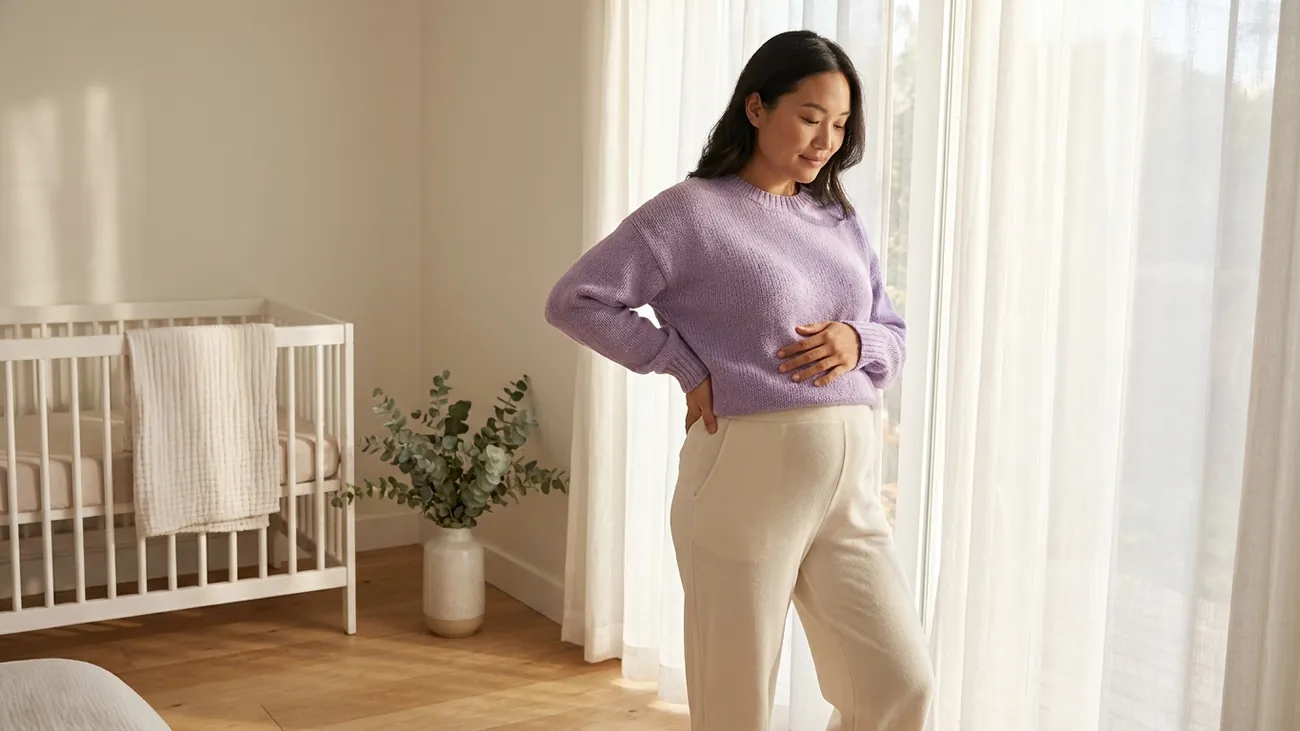
Your baby is here, but your tummy still looks a little pregnant. Or you notice a soft ridge down the middle when you sit up. Many mums wonder the same two things: is this diastasis recti, and will the gap close? This guide answers both with the research, shows you a simple self-check, and explains the treatment options in Singapore, from deep-core exercise and better posture to our non-invasive HIFEM programme.
Is it true that about half of new mums get diastasis recti?
Roughly, yes. But the number depends on when you measure. The best-known study followed 300 first-time mums in Norway from pregnancy to their baby’s first birthday. It counted a gap of two finger widths or more, above, at or below the belly button (Sperstad and colleagues, British Journal of Sports Medicine, 2016). A third of the mums already had a gap halfway through pregnancy. After birth, the numbers looked like this:
Share of 300 first-time mums with a gap of two finger widths or more. Source: Sperstad and colleagues, 2016.
So “about half” is a fair way to describe the first six months. Cleveland Clinic gives a similar picture: about 6 in 10 women after childbirth, and 45% at six months. Two things follow from these numbers. First, a gap is common, and it does not mean something went wrong. Second, it does not always close by itself. In the same study, about a third of mums still had a gap a year after birth.
About 6 in 10 mums have a tummy gap at six weeks. Most gaps narrow with time, but about 1 in 3 mums still has one at 12 months. That is why it is worth checking, not just waiting.
Diastasis recti or just a postpartum belly?
Two long muscles run down the front of your tummy. During pregnancy, your growing womb pushes them apart and makes them longer and weaker. That separation is diastasis recti. The NHS says it is usually about two finger widths, and usually goes back to normal by the time your baby is 8 weeks old.
Not every postpartum belly is diastasis recti, though. After birth, your womb takes up to six weeks to shrink from about the size of a grapefruit to the size of a pear. So it is normal to look as if you still have a bump for a while. Breastfeeding helps the womb contract faster. Swelling and stretched skin also take time to settle.
These signs point to a gap rather than a normal postpartum tummy (Cleveland Clinic):
- a bulge or “pooch” just above or below your belly button
- a soft, jelly-like feel around the belly button
- a ridge that cones or domes when you tense your tummy or sit up
- lower back pain, or trouble lifting and doing everyday tasks
The gap itself does not hurt. Pain comes from its knock-on effects, such as back strain, so any pain is worth getting checked. If the gap has closed and you would simply like help with a soft tummy, our Body & Contouring treatments are a separate option.
How to check yourself at home
This quick check follows Cleveland Clinic’s self-test:
- Lie on your back with your knees bent and your feet flat on the floor.
- Put one hand behind your head. Lift your head and shoulders slightly, as if starting a small sit-up.
- Rest your other hand on your tummy, palm down, fingers pointing to your toes. Press gently along the middle, above, at and below your belly button.
- Count how many fingers fit into any gap between the two muscle edges. Notice whether your tummy domes up.
A gap of two finger widths or more is worth mentioning to your doctor. The home check is only a rough guide. A doctor or women’s health physiotherapist can assess it properly. At BMB, every Core Recovery consultation starts by checking how wide the separation is.
What does my self-check mean?
Answer three quick questions for a suggested next step. A rough guide only, not a diagnosis.
See a doctor or physio first if…
- the gap is still obvious 8 weeks after the birth. The NHS advises contacting your GP, as you may be at risk of back problems.
- the gap is more than two finger widths, or you have pain (Cleveland Clinic).
- you have a lump at or near your belly button that is painful, hard, getting bigger or does not go away. This can be an umbilical hernia.
- you leak urine, or have pelvic or hip pain, or pain during sex. These can come with diastasis recti, and a women’s health physiotherapist can help.
- you had a caesarean. Let your doctor check your wound and clear you before any core programme or treatment.
Get urgent medical help if you have very bad tummy pain that does not go away, you are being sick, a hernia swells and the skin around it changes colour, or you cannot pass wind or poo (NHS).
What helps close or manage the gap
There is no single fix. Most mums do best with three things together: targeted deep-core exercise, better posture and lifting habits, and, for some, a non-invasive treatment such as HIFEM once they are ready.
Targeted deep-core exercise
The NHS says regular pelvic floor and deep stomach exercises can help reduce the gap. Try this one: lie on your side with your knees slightly bent. Breathe in and let your tummy relax. As you breathe out, gently draw your lower tummy in like a corset and squeeze your pelvic floor. Hold for a count of 10 while breathing normally, then relax. Repeat up to 10 times.
Posture and everyday lifting
Stand tall and notice your posture. Keep your back straight and bend your knees when you lift (NHS). To get out of bed, roll onto your side and push up with your arms, and avoid lifting anything heavier than your baby for now (Cleveland Clinic). In the Norwegian study, mums who did heavy lifting 20 or more times a week were about twice as likely to still have a gap at 12 months.
Support, not a fix
An elastic belly band can help hold your tummy in and support your lower back (Cleveland Clinic). A traditional bengkung wrap can feel supportive too, but a wrap does not close the gap on its own. Our bengkung belly binding guide explains why.
What to skip for now
Sit-ups, crunches, planks, push-ups and double leg lifts, plus any move that makes your tummy cone or dome (Cleveland Clinic). The NHS also advises avoiding high-impact exercise at first, straining on the toilet and heavy lifting.
What the research says about diastasis recti exercises
Exercise is the usual first step, and it is good for you in many ways. But be realistic about what it does to the gap itself. A 2025 review of 65 studies in the British Journal of Sports Medicine found low-certainty evidence that abdominal training narrows the gap more than no exercise. It found stronger evidence that pelvic floor training lowers the odds of leaking urine. A 2026 update in the journal Hernia pooled trials of deep-core exercise on its own and found no clear difference in the gap compared with little or no exercise, while noting that exercise may still help how your core works and feels.
In short, exercise is worth doing for strength, comfort and your pelvic floor. If the gap stays wide, it may need more than exercise alone. For a stage-by-stage return to activity, see our guide to postnatal exercise in Singapore.
Non-invasive HIFEM: BMB’s Core Recovery programme
For mums who want more than home exercise, our diastasis recti treatment, Core Recovery, uses HIFEM (high-intensity focused electromagnetic) technology. You lie back comfortably while the device sends focused electromagnetic energy to your tummy muscles. This makes them contract powerfully, with no physical effort from you. The aim is a stronger core and a smaller gap.
How it works at BMB:
- It starts with a consultation. We check how wide the separation is, go through your medical history and goals, and plan your sessions.
- The recommended course is 5 to 6 sessions, 2 to 3 a week, with at least 48 hours between sessions.
- There is no downtime. Some mums feel muscle soreness, like after a workout, for a day or two.
- Follow-up sessions every 2 to 3 months help keep the results.
- You can book at our Orchard (Paragon) clinic in Singapore or at our Johor Bahru branch.
Who it is not for. HIFEM is not suitable during pregnancy or while you are breastfeeding. It is also not suitable if you have a pacemaker, metal implants (including a metal IUD), epilepsy, a fever, or certain other conditions. We go through the full list of contraindications at your consultation.
What the evidence shows. HIFEM for diastasis recti is newer, and the research is still small. In a 2020 pilot study, 10 postpartum women had four HIFEM sessions, and MRI scans showed the gap was about 23% narrower six months later. The authors said studies with a control group are still needed. A 2023 review of electromagnetic body-contouring studies found the average changes were small, with no statistically clear narrowing of the gap, and noted that most studies were written by advisers to the device maker. So we see HIFEM as extra strength work on top of your deep-core exercises, not a replacement for them.
Diastasis recti in Singapore: a sensible timeline
- Weeks 0 to 6, confinement: rest, gentle walks and pelvic floor exercises when you feel ready. Many mums book a postnatal massage for comfort and circulation, from 7 days after a normal delivery, or from 3 weeks after a caesarean or when your gynae recommends. Massage is for comfort and recovery, alongside your deep-core exercises.
- Around 6 to 8 weeks: do the self-check and raise it at your postnatal check-up. Keep up gentle deep-core work. No sit-ups or planks yet.
- From 8 weeks: if the gap is still obvious, see your GP and ask about a women’s health physiotherapist.
- Once you have stopped breastfeeding and your doctor is happy: if you would like extra help, book a Core Recovery consultation to see whether HIFEM suits you.
- A very wide gap or a hernia: some women need surgery, such as a tummy tuck (abdominoplasty). That is a decision for a surgeon (Cleveland Clinic).
Frequently asked questions
Is it true that about half of new mums get diastasis recti?
Roughly, yes. In a study of 300 first-time mums, 60% had a gap of two finger widths or more at 6 weeks after birth, 45% at 6 months and about a third at 12 months (Sperstad and colleagues, 2016). So about half is a fair summary of the first six months.
Can diastasis recti close on its own?
Often, yes. The NHS says the gap usually goes back to normal by the time your baby is 8 weeks old. But not always: about a third of mums in the Norwegian study still had a gap at 12 months. If it is still obvious at 8 weeks, see your GP.
What is the best diastasis recti treatment in Singapore?
Start with an assessment and targeted deep-core exercise, ideally guided by a women’s health physiotherapist, plus good posture and lifting habits. If you want more help once you have stopped breastfeeding, BMB offers a non-invasive HIFEM Core Recovery programme at our Orchard (Paragon) clinic. Surgery is for severe cases or when there is a hernia.
Can I have HIFEM while breastfeeding?
No. BMB does not offer HIFEM during pregnancy or while you are breastfeeding. Keep up your deep-core and pelvic floor exercises for now, and book a consultation once you have stopped.
Will sit-ups or planks help close the gap?
No. The NHS advises avoiding sit-ups, planks and high-impact exercise to start with, and Cleveland Clinic advises skipping any move that makes your tummy cone or dome. Start with gentle deep-core breathing and pelvic floor work.
Does a belly binder or bengkung close the gap?
Not on its own. A belly band can help hold your tummy in, support your lower back and remind you to use good posture, but it cannot heal the gap or strengthen your core (Cleveland Clinic).
Sources
- Sperstad JB, Tennfjord MK, Hilde G, Ellström-Engh M, Bø K. Diastasis recti abdominis during pregnancy and 12 months after childbirth: prevalence, risk factors and report of lumbopelvic pain. British Journal of Sports Medicine, 2016.
- NHS. Your post-pregnancy body and Umbilical hernia.
- Cleveland Clinic. Diastasis recti (abdominal separation) and Uterus involution.
- Beamish NF and colleagues. Impact of postpartum exercise on pelvic floor disorders and diastasis recti abdominis: a systematic review and meta-analysis. British Journal of Sports Medicine, 2025.
- Lyons G and colleagues. What is the evidence for abdominal and pelvic floor muscle training to treat diastasis recti abdominis postpartum? An updated systematic review and meta-analysis of randomized clinical trials and trial sequential analysis. Hernia, 2026.
- Jacob CI, Rank B. Abdominal remodeling in postpartum women by using a high-intensity focused electromagnetic (HIFEM) procedure: an investigational MRI pilot study. Journal of Clinical and Aesthetic Dermatology, 2020.
- Swanson E. A systematic review of electromagnetic treatments for body contouring. Annals of Plastic Surgery, 2023.
This article is general information, not medical advice, and cannot diagnose any condition. If you are worried about your tummy, your back or a lump, please see a doctor. Published 25/09/2026.