

Breast Milk Storage in Singapore: How Long Milk Lasts, From Room to Freezer
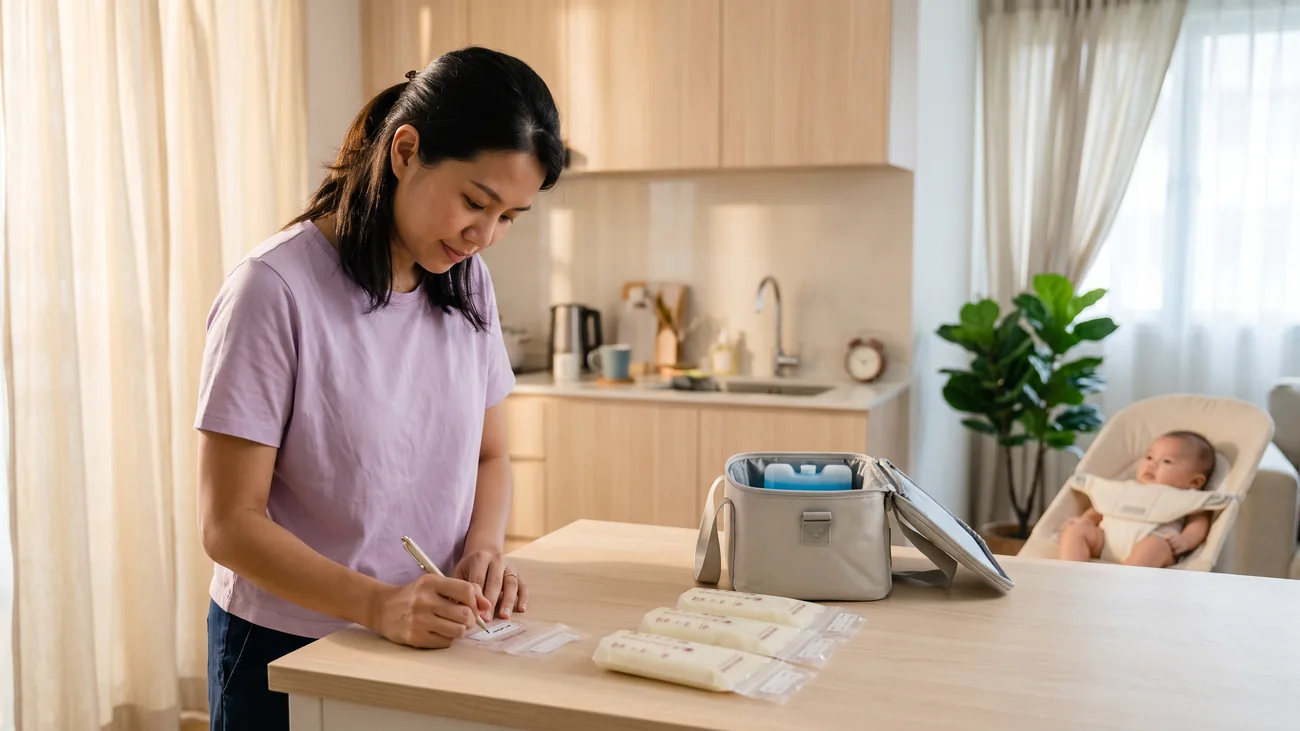
Freshly expressed breast milk keeps for up to 4 hours at room temperature, 24 hours in an insulated cooler bag with frozen ice packs, 48 hours in the fridge and about 6 months in a deep freezer. Those are the most cautious figures from HealthHub Singapore, the US CDC and the Academy of Breastfeeding Medicine (ABM). In Singapore, watch the room-temperature window most closely, because many homes are warmer than the 25°C those guides assume. Thawed milk keeps 24 hours in the fridge and is never refrozen.
How long does breast milk last at room temperature in Singapore?
Up to 4 hours. The CDC gives up to 4 hours at 25°C (77°F) or colder, and HealthHub gives the same 4 hours at 25°C. The catch is that Singapore days are warmer. The Meteorological Service Singapore says temperatures usually run from 23 to 25°C at night up to 31 to 33°C in the day. Unless you are in air-conditioning, your kitchen is probably warmer than the guides assume.
Of these sources, only the ABM protocol looks at hotter rooms. It notes that bacteria grow faster in warmer rooms, and that 4 hours may be a reasonable limit at 27 to 32°C. Its longer 6 to 8 hours applies only to very clean milk in cooler rooms. If you will not feed the milk soon, chill it straight away. No source gives a safe time above 32°C, such as in a parked car.
In our heat, treat 4 hours at room temperature as the limit, not the target.
How long does expressed milk keep in the fridge and freezer?
Guidelines do not fully agree. A 2020 review of ten widely cited online guides found great variation, from 4 to 10 hours at room temperature and from 72 hours to 8 days in the fridge. Where our sources differ, this table uses the more cautious figure.
| Where the milk is | Use within |
|---|---|
| Room, 25°C or cooler | 4 hoursCDC, HealthHub, ABM |
| Room, 26 to 32°C | 4 hours at most; chill soonerABM only |
| Insulated cooler bag with frozen ice packs | 24 hoursCDC, HealthHub, ABM, NHS |
| Fridge, at the back | 48 hoursHealthHub; others allow 3 to 8 days |
| Ice compartment inside a one-door fridge | 2 weeksNHS |
| Freezer of a two-door fridge (−5 to −15°C) | 3 monthsHealthHub gives 3 to 6 months |
| Deep freezer (−18°C or colder) | 6 monthsCDC: up to 12 months acceptable |
| Thawed, kept in the fridge | 24 hours from fully thawedCDC, HealthHub; never refreeze |
| Left in the bottle after a feed | 1 hour, then throw awayNHS; CDC allows 2 hours |
The fridge is where sources differ most. Even HealthHub’s storage infographic says 48 hours, while its article for working mums says 72 hours. The CDC and ABM allow 4 days, and the NHS up to 8 days at 4°C or lower, but only 3 days at 5 to 10°C. A family fridge opened all day may not hold a steady 4°C, so we use 48 hours. Freeze any milk you will not use by then.
How do I keep milk cold on the way home from work?
Use an insulated cooler bag with frozen ice packs. The CDC, ABM, HealthHub and NHS all give up to 24 hours this way. HealthHub suggests expressing at lunch and just before you leave work, and keeping the milk in the fridge until then. A shared office fridge is fine if the milk is labelled with your name and the date (ABM). For the MRT or bus:
- Freeze the ice packs solid, and pack the milk so it touches them.
- Keep the bag zipped and out of the sun.
- At home, feed the milk, refrigerate it or freeze it straight away (CDC).
The 24-hour figure rests on little research: the ABM notes that very few studies have tested milk at about 15°C, roughly the temperature of a small cooler with an ice pack.
How should I label milk and make space in a home freezer?
- Label every container with the date you expressed it (CDC). Add your baby’s name if it is going to infant care.
- Freeze one feed at a time, about 60 to 120 mL (2 to 4 ounces), says the CDC. Smaller portions also cut waste (ABM).
- Leave about 2.5 cm at the top, because milk expands as it freezes (CDC).
- Store milk at the back, never in the door (CDC), and away from the walls of a self-defrosting freezer (ABM).
- Use breast milk storage bags or food-grade containers with tight lids, not ordinary plastic bags (CDC). The ABM advises avoiding bisphenol A (BPA).
- Thaw the oldest milk first (CDC).
Freezer space goes fast in a home fridge. Freeze bags flat, then stand them upright in a box in date order. On HealthHub’s figures, a two-door fridge freezer keeps milk for 3 to 6 months and a deep freezer at −20°C for 6 to 12 months, so a deep freezer helps if you are building a big stash.
How do I hand over breast milk to infant care?
The CDC and ABM both say to label each container with your child’s name as well as the date. The ABM notes that babies in daycare typically take 60 to 120 mL at a feed, so feed-sized portions save waste. Carry the milk in a cooler bag with frozen ice packs, and ask the centre how it stores, thaws and warms milk. If frozen milk starts to thaw on the way, tell the staff: thawed milk should be used within 24 hours and never refrozen (CDC).
How do I thaw and warm breast milk safely?
Thaw it in the fridge overnight, in a bowl of warm water, or under lukewarm running water (CDC). The fridge loses less fat (ABM). Never use a microwave or the stove: the NHS warns of hot spots that can burn your baby’s mouth, and the ABM says microwaving lowers the milk’s immune factors.
To warm milk, stand the sealed container in lukewarm water, no hotter than 40°C (ABM). Swirl to mix the fat back in, and test a few drops on your wrist (CDC). Your baby can also drink it cold.
Use thawed milk within 24 hours if it stays in the fridge (CDC, HealthHub). Once warmed, HealthHub says to use it straight away; the CDC allows 2 hours. Never refreeze thawed milk: the CDC, HealthHub and NHS all say no, and the ABM found too little evidence to recommend it.
What should I throw away?
Every drop feels precious (it is not called liquid gold for nothing), but throw away:
- milk left at room temperature for more than 4 hours
- thawed milk kept in the fridge for more than 24 hours
- milk left in the bottle after a feed. The NHS says to use it within 1 hour of your baby starting to drink, then throw the rest away.
- thawed milk that has been refrozen
- milk that looks stringy or smells foul (ABM)
A soapy smell on its own is usually not spoilage. The ABM explains that an enzyme (lipase) breaks down fat during storage and changes the smell, and there is no evidence that babies often refuse it. Do not scald milk to stop this: heating above 40°C may destroy immune factors (ABM).
When does my breast milk need to be used by?
Breast milk use-by calculator
Pick where your milk is and when it was expressed. Where the sources give different times, this calculator uses the more cautious one.
When should I see a doctor or lactation consultant?
- Your baby was born early, is unwell or is in hospital. The ABM protocol is written for healthy, full-term babies at home. The NHS advises asking the hospital staff caring for your baby how to store milk for a premature or sick baby.
- Your baby seems unwell after a feed, for example with vomiting, diarrhoea or a fever. See a doctor, and say what milk was fed and how it was stored.
- Your breasts stay hard, lumpy or painful, or you feel feverish. Our guide to blocked milk ducts and engorgement covers the warning signs of mastitis.
- You are going back to work and want a plan. At The Lactation Clinic, Sister Yasa, our Head Consultant and an IBCLC, can help you create a practical pumping and milk-storage plan.
- Feeding itself is hard, with latch pain or supply worries. Our guide to breastfeeding for first-time mums is a good start.
For painful engorgement, some mums also book our Signature Lactation Massage. If you are still pregnant, our Harvesting Colostrum Course covers hand expression and how to label, freeze and transport colostrum, from 37 weeks and only once your obstetric team confirms it suits your pregnancy.
Frequently asked questions
How long can breast milk stay out at room temperature in Singapore?
Up to 4 hours. The CDC and HealthHub give 4 hours at 25°C or cooler. Rooms without air-conditioning in Singapore are often warmer, and the ABM says 4 hours may be a reasonable limit at 27 to 32°C. If you will not use the milk soon, chill it straight away.
Can I refreeze breast milk after it has thawed?
No. The CDC, HealthHub and the NHS all say not to refreeze thawed milk. Keep thawed milk in the fridge and use it within 24 hours, and use warmed milk straight away.
Can I mix fresh breast milk with older stored milk?
Yes, once the fresh milk is cold. The ABM advises chilling newly expressed milk before adding it to older stored milk, and never adding warm milk to frozen milk. Label the container with the date of the oldest milk.
Does freezing breast milk lose nutrients?
A little, over time. The ABM reports that fat, protein and calories are lower after 90 days frozen, and vitamin C falls after 1 to 5 months, while some immune factors stay stable for 6 months. These studies are small. Fresh milk is best, but frozen milk is still a very good food for your baby.
How do I bring breast milk to infant care?
Label each container with your baby’s name and the date you expressed it, pack feed-sized portions of about 60 to 120 mL, and carry them in a cooler bag with frozen ice packs. Ask the centre how it stores, thaws and warms milk, and what it does with leftovers.
What does spoiled breast milk smell like?
Stored milk can smell soapy or a little different because an enzyme called lipase breaks down its fat, and the ABM says this is not a sign of spoilage. Throw away milk that looks stringy or smells foul, and any milk past its storage time.
Sources
- Eglash A, Simon L, Academy of Breastfeeding Medicine. ABM Clinical Protocol #8: Human Milk Storage Information for Home Use for Full-Term Infants, Revised 2017. Breastfeeding Medicine, 2017. Full text (PDF).
- Centers for Disease Control and Prevention (CDC). Breast Milk Storage and Preparation.
- HealthHub Singapore, Health Promotion Board. Breast milk 101: Storing, freezing and thawing (infographic) and Mummy’s off to work.
- NHS. Expressing and storing breast milk.
- Scott H, Sweet L, Strauch L, Muller A. Expressed breastmilk handling and storage guidelines available to mothers in the community: a scoping review. Women and Birth, 2020.
- Meteorological Service Singapore. Climate of Singapore.
This article is general information for healthy, full-term babies, not medical advice. If your baby is premature or unwell, please follow your doctor’s or hospital’s advice. Published 12/10/2026.