

Reduce Painful Groins with a Prenatal Massage
If you are faced with painful groins during pregnancy, you aren’t alone. Pain over the pubic bone, in the groin and down the inner thighs is one of the signs of pelvic girdle pain (PGP), and the NHS estimates that PGP affects up to 1 in 5 pregnant women to some degree. That matches the European guidelines on PGP, which put it at about 20% of pregnant women at any one time (Vleeming and colleagues, European Spine Journal, 2008). Back pain in general is even more common: studies report it in 50 to 80% of pregnancies (Sabino and Grauer, 2008). PGP can range from a mild ache to pain that makes it hard to get around, but the NHS is clear that it is not harmful to your baby.
Symptoms of painful groins
Although the most common symptoms include pain in the groin and pubic area, you may also experience other related discomforts that signal pelvic girdle pain. Each of these can show up alone or together, and they often worsen as the baby grows and your posture changes. The list below follows the symptoms the NHS describes.
Hip & back pain
Pain across your lower back and at the back of your pelvis, commonly worsening as your bump grows and your posture changes. It can spread into your hips and thighs as the day goes on.
Pain between the legs
Pain in the area between your vagina and anus (the perineum) or down the inside of your thighs, especially when standing for long periods, walking or climbing stairs.
Clicking sensation
A clicking or grinding feeling in your pelvic area. It can feel strange, so mention it to your midwife or doctor when you describe your symptoms.
Worse at night
Pain that gets worse at night when you’re trying to sleep, particularly when turning over in bed. The NHS suggests a pillow between your legs for extra support in bed.
Movement triggers
Pain while walking, going up or down stairs, or moving your legs apart, for example getting in and out of a car. Keeping your knees together as you get in and out helps, and so does avoiding heavy lifting.
Standing on one leg
Pain when your weight goes onto one leg, such as stepping into trousers or climbing stairs. The NHS suggests sitting down to get dressed and spreading your weight evenly across both legs when you stand.
Up to 1 in 5 pregnant women have pelvic girdle pain. You’re far from alone, and the symptoms are manageable.
What causes painful groins, and who is most at risk?
The NHS describes PGP as stiffness of your pelvic joints, or the joints moving unevenly. The weight and position of your baby can add to the strain. On top of that, the ligaments in your body naturally become softer and stretch to prepare you for labour, which puts strain on the joints of your lower back and pelvis (NHS). If your body cannot adapt fast enough, you get painful groins.
According to the NHS, you are more likely to get PGP if you have a history of lower back or pelvic girdle pain, had PGP in a previous pregnancy, have injured your pelvis before (in a fall or accident, for example), have a physically demanding job, or are overweight. The European guidelines agree that previous back pain and a previous pelvic injury are the most likely risk factors, and found that smoking is not one. Getting diagnosed early can help keep the pain to a minimum and avoid long-term discomfort, so tell your obstetrician at the first sign of pain and ask for a physiotherapy referral if needed. A physiotherapist can give you exercises to strengthen your pelvic floor, stomach, back and hip muscles, and may suggest a support belt.
Relief through prenatal massage
If you’ve ever had a professional massage, then you know that both your mind and body respond to it: you relax and tight muscles soften. The NHS lists a massage among the things that can help with back pain in pregnancy. In a small trial of 26 pregnant women, those who had two 20-minute massages a week for five weeks reported less anxiety, better mood, better sleep and less back pain by the end, and a stress hormone measured in their urine (norepinephrine) went down (Field and colleagues, 1999).
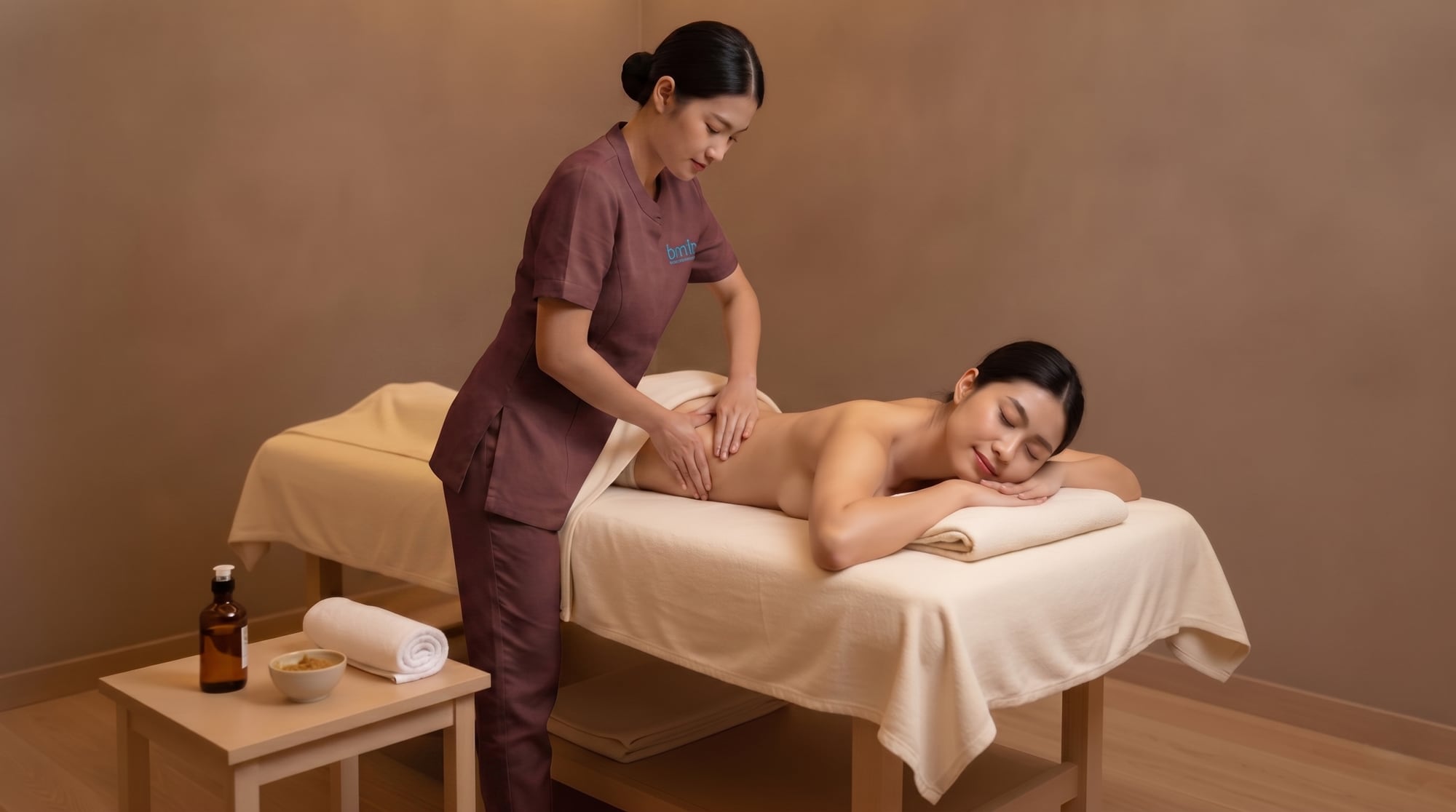
A prenatal massage in Singapore at BMB is set up for how your body works in pregnancy. You lie on your side or in a semi-reclined position, fully supported with pillows, and never face-down, so your bump stays supported throughout. Our therapists use safer pressure points and oils checked to be safe for pregnant and breastfeeding mums. Before the massage, our consultant talks through your pregnancy stage, concerns and medical history. We recommend prenatal massage between 16 and 36 weeks; past 36 weeks, we need a doctor’s letter of approval before booking. If you live in Johor or are crossing the Causeway anyway, the same side-lying method is used for prenatal massage in Johor Bahru at The Avenue M.
For painful groins specifically, it helps to be clear about what massage can and cannot do. It can relax the hip, buttock and lower-back muscles, which often work harder when the pelvic joints are sore, and that eases the dull ache that builds through the day. It is comfort care, though, not a fix for the joint itself. The strongest research for pregnancy back and pelvic pain is on exercise: a Cochrane review of 34 trials found that an 8 to 12 week exercise programme reduced the number of women reporting low back and pelvic pain, while single studies suggested acupuncture or craniosacral therapy may help pelvic pain (Liddle and Pennick, Cochrane, 2015). So the best plan for most mums is physiotherapy for the joint, with massage alongside for comfort and rest. The NHS notes that PGP tends not to get completely better until the baby is born, but treatment can improve the symptoms during pregnancy, and we recommend regular sessions to keep up the benefits.
When to call your doctor or midwife
Speak to your midwife or doctor if moving around is getting difficult or the pain is affecting your daily life. The NHS also advises getting help urgently if you have back pain in your second or third trimester, as it could be a sign of early labour, or if back pain comes with a fever, vaginal bleeding, pain when you pee, or pain in your side under your ribs. If you lose feeling in one or both legs, your bottom or your genitals, go to A&E straight away. Before any massage, please check with your doctor first if you have a high-risk pregnancy, pregnancy-induced hypertension, preeclampsia, a history of pre-term labour, or severe swelling, high blood pressure or sudden severe headaches.
Groin pain in pregnancy: common questions
How common is groin pain in pregnancy?
Groin and pubic pain is one of the signs of pelvic girdle pain (PGP). The NHS estimates that PGP affects up to 1 in 5 pregnant women to some degree, and European guidelines put it at about 20% of pregnant women at any one time. Back pain in general is more common still, reported in 50 to 80% of pregnancies.
Is pelvic girdle pain harmful to my baby?
No. The NHS says PGP is not harmful to your baby, although it can be painful and make it hard to get around. Many women with pelvic pain in pregnancy can have a normal vaginal birth. It helps to write in your birth plan that you have PGP, so the people supporting you in labour know about it.
Does prenatal massage help pelvic girdle pain?
Massage can ease the tight hip, buttock and lower-back muscles that build up around a sore pelvis, and a small trial found pregnant women who had regular massage reported less back pain, less anxiety and better sleep. It does not fix the joint itself. The strongest evidence is for exercise and physiotherapy, so most mums do best with physio for the joint and massage alongside for comfort.
When can I have a prenatal massage at BMB?
We recommend prenatal massage between 16 and 36 weeks of pregnancy. If you are past 36 weeks, we need a doctor’s letter of approval before booking. You lie on your side or semi-reclined, never face-down, at our Orchard (Paragon) or Johor Bahru branch. Check with your doctor first if you have a high-risk pregnancy, high blood pressure, preeclampsia or a history of pre-term labour.
When should I see a doctor about groin or pelvic pain?
See your midwife or doctor if moving around is getting difficult or the pain is affecting your daily life. Get help urgently if you have back pain in your second or third trimester, as it could be a sign of early labour, or if the pain comes with fever, vaginal bleeding or pain when you pee. Go to A&E straight away if you lose feeling in your legs, bottom or genitals.
Sources
- NHS. Pelvic pain in pregnancy and Back pain in pregnancy.
- Vleeming A, Albert HB, Ostgaard HC, Sturesson B, Stuge B. European guidelines for the diagnosis and treatment of pelvic girdle pain. European Spine Journal, 2008.
- Sabino J, Grauer JN. Pregnancy and low back pain. Current Reviews in Musculoskeletal Medicine, 2008.
- Liddle SD, Pennick V. Interventions for preventing and treating low-back and pelvic pain during pregnancy. Cochrane Database of Systematic Reviews, 2015.
- Field T, Hernandez-Reif M, Hart S, Theakston H, Schanberg S, Kuhn C. Pregnant women benefit from massage therapy. Journal of Psychosomatic Obstetrics and Gynaecology, 1999.
This article is general information, not medical advice, and cannot diagnose any condition. If you have pain in pregnancy, please see your doctor or midwife. Updated 05/10/2026.